
Jared Burgess is a member of Eastgate Christian Centre, a Baptist church in East Auckland, and works at World Vision as Director of Information and Solutions.
The advocacy of churches, including the Baptist Churches of New Zealand; children’s charities like World Vision New Zealand; and investors and businesses have helped to usher in a historic move to fast-track modern slavery legislation through Parliament.
National and Labour have announced that they will invoke a never-before-used Parliamentary rule to progress a joint Modern Slavery Bill co-sponsored by National MP Greg Fleming and Labour MP Camilla Belich.
World Vision’s Head of Advocacy and Justice Rebekah Armstrong says the bi-partisan decision is momentous.
“This shows what can happen when our leaders put politics aside and work together to do what’s right. After years of advocacy and widespread public support, politicians from across the aisles are finally moving to make modern slavery legislation a reality.
This move means New Zealand is at last playing its part to help end modern slavery for more than 50 million people worldwide, including 8,000 right here in New Zealand,” she says.
The Modern Slavery Bill will introduce:
● Mandatory reporting: requiring businesses and other entities with a consolidated revenue of more than $100 million to prepare, submit, and publish public annual modern slavery statements which detail incidents, risks, due diligence, remediation, complaints, and training across operations and supply chains.
● Greater transparency and accountability: through an online public register of modern slavery statements, and annual reports detailing incidents, risk trends, offences, and civil penalties.
● Enhanced support for victims: through requirements to guide government agency support, improve victim identification, and the services available to trafficking survivors.
● Improved national data collection to track the scale of modern slavery, along with a regular review to strengthen modern slavery legislation in New Zealand.
World Vision research shows that the average New Zealander spends around $77 a week[1] on goods that are likely linked to child labour, forced labour, or human trafficking such as electronics, clothing, and toys.
“Kiwis don’t want to be complicit in exploitation. This new law will require companies to take responsibility and gives New Zealanders confidence that the goods they are buying are slavery-free,” Armstrong says.
She says churches, including the Baptist congregations around the country, along with the New Zealand business community, local and international investors, and the broader New Zealand public have continually called for modern slavery laws and will welcome this latest move.
“We’re especially grateful for the support we’ve had from Baptist churches in calling for justice and care for the vulnerable. This legislation is a response to those collective voices raised in compassion and conviction,” she says.
As Baptist communities committed to justice, mercy, and walking humbly with God (Micah 6:8), we see this legislative progress as a tangible outworking of our faith. The fight against modern slavery is not only political—it is deeply spiritual. It is about restoring dignity, protecting the vulnerable, and challenging systems of exploitation.
Please join us in continuing to pray for wisdom for our leaders, courage for advocates, and justice for all who remain trapped in slavery—in New Zealand and around the world.
Notes
[1] https://www.worldvision.org.nz/about/media/new-zealand-households-spend-77-a-week-on-goods/
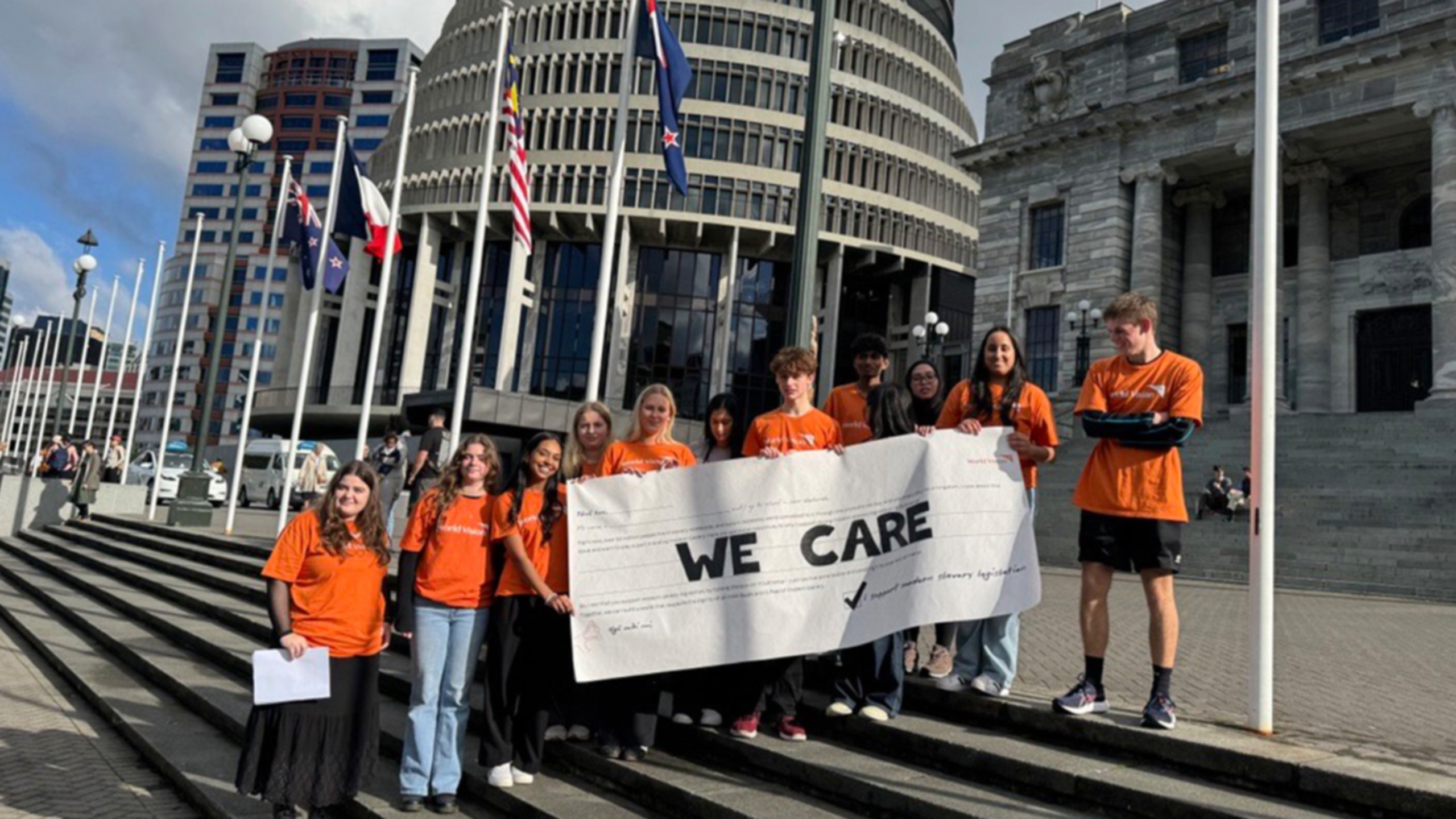
Photo supplied by Jared Burgess: World Vision Advocacy Ambassadors campaigning for modern slavery legislation at Parliament.


