

This article provides helpful insight into the need of supervision for people in pastoral ministry roles in the church. It is based on recent New Zealand Baptist research. While written for pastors, anyone working closely with pastoral leaders such as church Elders, governance boards, and pastoral search teams may find this of interest.
Many people-centric roles in society have compulsory registration such as school teachers, doctors, nurses, midwives, social workers, lawyers and police officers. There is no such requirement for church leaders in New Zealand. The Baptist Churches of New Zealand have a voluntary registration process for pastors, missional leaders, kairahi Māori and chaplains, that provides a clear framework for ongoing development and accountability and includes ministry supervision.
Currently two-thirds of our pastors are registered, although not all pastors fulfil the requirements of registration, eg: working insufficient hours in the role, or have language barriers. The Baptist Leadership Coordination Director, Karen Warner says it should be noted that 90% of eligible pastors are registered. This article refers to registered pastors as ‘Baptist registrants’.
Neil Baker is Senior Pastor at the Auckland Baptist Tabernacle, a multi-cultural, multi-congregational faith community based in Auckland’s CBD. He has been a fully registered Minister within the Baptist Churches of New Zealand since 2002. Neil is qualified in professional supervision, counselling, not-for-profit management, and pastoral leadership. This article comes out of his recent Master of Applied Theology research through Carey Baptist College. Neil has also written the article: My supervision experience.
The benefits of ministry supervision are significant, with pastors themselves identifying ministry supervision as a key practice to help them mitigate crises in ministry.[1]
My own research also bears this out and specifically looks at the factors that both hinder and enhance Baptist registrants (pastors church leaders, missional leaders, and chaplains) to better engage in reflective ministry supervision.[2]
Interestingly, the research revealed a range of attitudes by Baptist pastors and registrants about ministry supervision. Many of our Baptist registrants saw the value of the Baptist Unions’ increased focus on ministry supervision - what we term External Supervision Support [3] - as a needed and positive development. However, some registrants were resistant of our new approach, viewing ministry supervision as either a box-ticking exercise, an unnecessary activity for already busy and experienced pastors, or simply as a waste of time.
Thankfully, the later were the minority views. However, it got me thinking as to why some of our registrants had this perspective:
- Had they experienced poor or unhelpful supervision in the past?
- Maybe they hadn’t yet experienced the benefits of supportive and empowering supervision as External Supervision Support is intended to be?
- Maybe they are naïve to the need of supervision or are allowing arrogance and/or insecurity to influence their responses?
- Maybe we just haven’t done a good enough job at envisioning the value of good ministry supervision practice?
- Or maybe it just reflects the busyness of our pastors and leaders and that meaningful engagement in ministry supervision takes time, intentionality, and has a financial cost?
I suspect all these factors are likely; however, the research highlights some key reasons for resistance by pastors and church leaders to ministry supervision. Let’s drill down on these further.
In his insightful article A Challenge to Church Leaders: The Necessity of Supervision for Ordained Ministers [4], Ryan LaMothe (Ph.D./Associate Professor of Pastoral Care and Counselling) outlines some of the key benefits of ministry supervision; supportive care, loving accountability, personal understanding (reflection and self-awareness), and lifelong learning. He also notes several reasons why clergy resist supervision. The first of these, and one that was clearly identified in my own research, is the avoidance of vulnerability by pastoral leaders.
Perhaps the single most common motivation for avoiding supervision is the fear of being vulnerable. It is ironic that ministers tell people that it is okay to be vulnerable, to seek help, to admit need, to rely on others, and yet many of us, men and women alike, tend to avoid taking our own advice. [5]
This is a telling comment. His reasonings why ministers may avoid being vulnerable in supervision deserves to be noted in full.
First, we fear being vulnerable because we might discover that we are not as competent as we believed or we might confront an aspect of ourselves that we prefer to remain hidden in the closet of our unconscious. Avoiding supervision, then, may be a way to preserve our self-esteem, while avoiding our shadow side. A second and related reason for one's avoidance of supervision is our ego ideal. Jesus Christ, for Christian ministers, is the ideal we hold for being and for doing ministry. Seminarians are encouraged to identify with Christ, to configure themselves to Christ, to incarnate Christ's love and compassion in their ministry. To be vulnerable, to open oneself up to supervision can mean encountering the pain of disillusionment. We are not nearly as good, virtuous, Christ-like, or skilled as we secretly believe. Of course, we may also wish to avoid public acknowledgement of our mistakes. Finally, guarding one's self-worth is often accompanied by the fear of the supervisor's rejection, disappointment, or disapproval. Many of us may have grown up with a sense that if we fail, the other person will leave us or disapprove of us. To protect ourselves from this, we tend to become perfectionists and perfectionists tend to resist supervision. [6]
We are not nearly as good, virtuous, Christ-like, or skilled as we secretly believe. Ouch! I can personally identify this fear of vulnerability in my own life. For the first 5 years of my pastoral ministry, I avoided being vulnerable with people. I had not been encouraged to consider supervision as part of my training for ministry, and it was not something actively encouraged in my first pastorate. Only when the pressures of my ministry and personal life started to take their toll did I actively look for someone to talk with outside my ministry context. It was scary, uncomfortable, but ultimately life-giving. I can honestly say that having an external supervisor has been a gift to me over the last 30 years of pastoral ministry and I credit this as one of the important reasons why I am still committed to Jesus and his Church today.
LaMothe’s second important reason why ministers resist engaging in supervision is simply and accurately described as ‘Hubris’. He puts it this way.
Closely associated with avoidance of vulnerability is hubris. It may be inevitable that selecting and training people to fulfil leadership roles in churches contributes to an elevated view of oneself. Of course, ministers would abhor this idea and practice because of the scriptural admonishments about pride. Rational and public pronouncements of servant-leadership and equality aside, there is a good deal of pride among the ranks of ordained ministers. I would venture to say one could scratch any ecclesial institution and find rationally justified and codified clericalism. To submit to supervision is an antidote to pride and a step toward humility. [7]
Ouch again! That statement cuts close to home for me. However, it also highlights why ministry supervision is so necessary. It is a space that we can learn to step aside from the pastoral persona we consciously and often unconsciously wear and choose to be open and honest with a supportive, encouraging, and confidential ministry supervisor. In doing so we are therefore choosing to be honest with God, honest with ourselves, and open to processing the real stuff of life and ministry. As one Baptist registrant commented in my research about the necessity of ministry supervision: “We are not the 4th member of the Trinity!” Ministry supervision is therefore an opportunity for us as pastors to be in a place of receiving (rather than giving), to be heard by another person (rather than being the person doing the hearing) and to be invited to share and reflect on the things that really matter. Meaningful supervision is an act of openness, vulnerability, and humility and therefore a space to process, reflect, and learn. We cannot have the later without the former. When openness, vulnerability and humility are present then ministry supervision can be the supportive, empowering, and reflective space we need it to be.
At this point I would like to share with you some of the key findings from my thesis research that align with LaMothe’s comments. In 2024, I did a qualitative survey of ministry supervisors and Baptists registrants to identify the qualities and practices that enhanced or hindered Baptist registrants to engage in reflective learning while taking part in ministry supervision. 99 supervisors providing ministry supervision to Baptist Registrants and 155 Baptist Registrants participated in the survey. This was a very positive response and has added depth and breadth to the research findings. Thanks to so many of you for your participation.
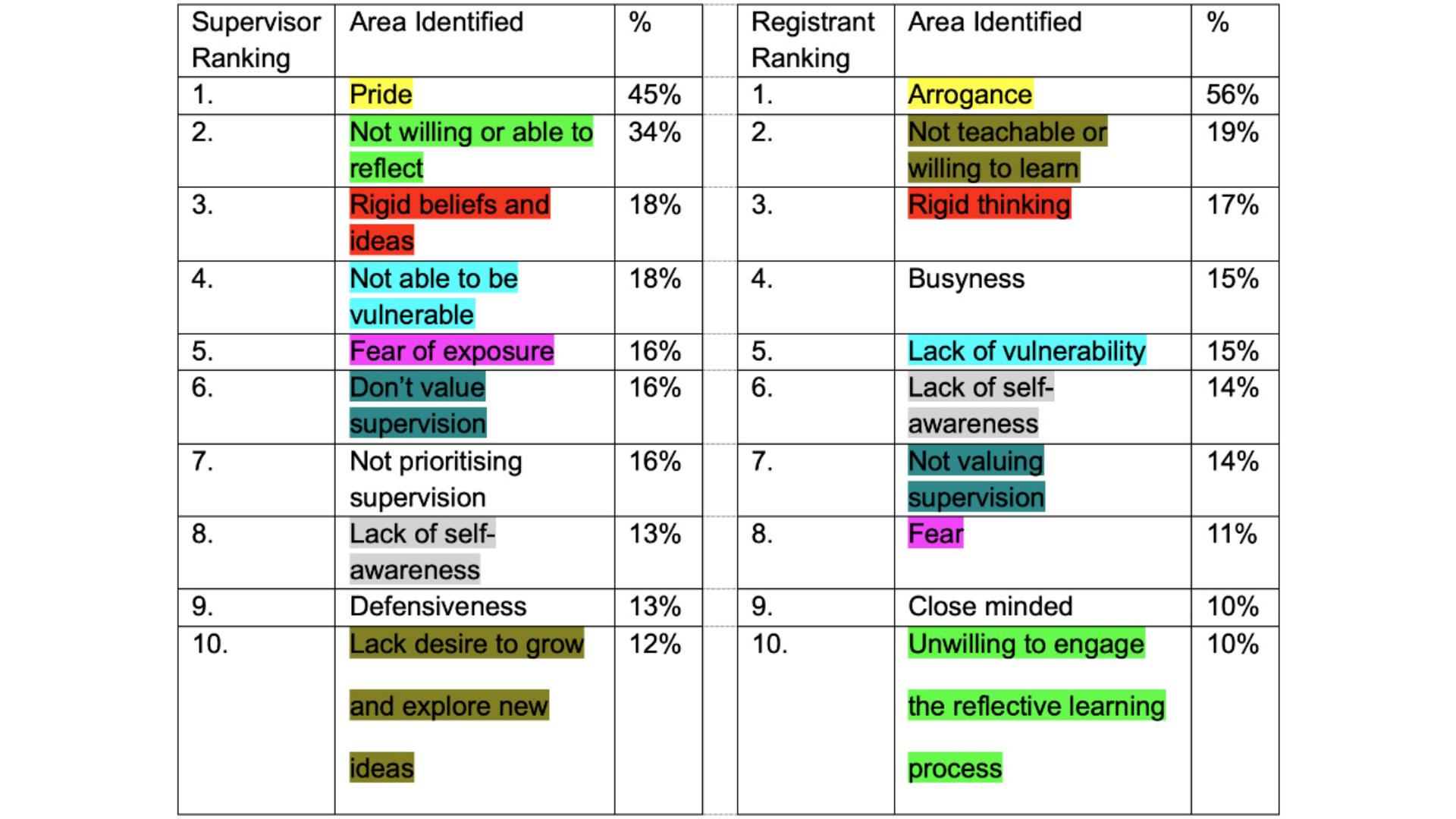
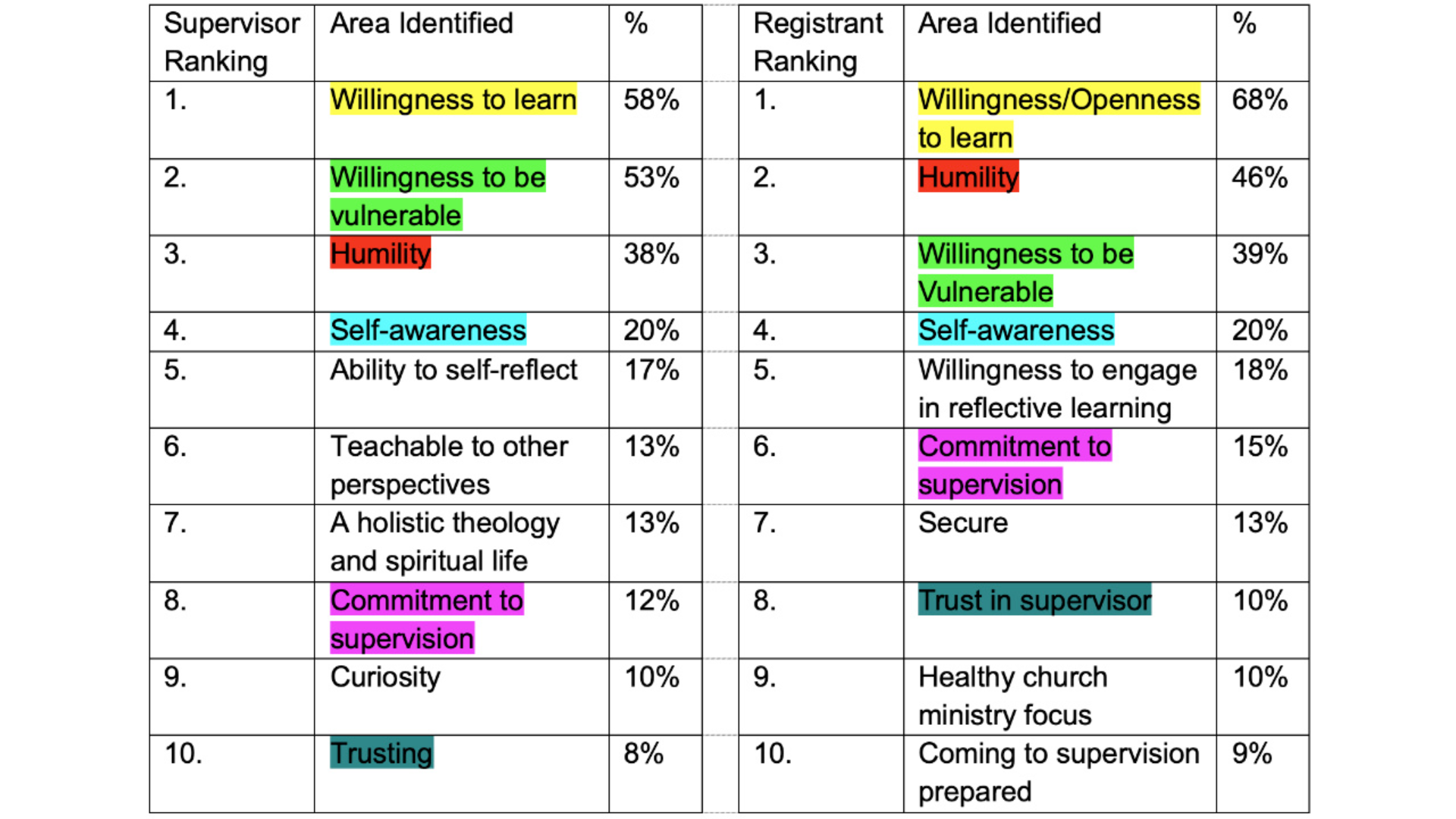
In this article I want to focus on key attitudes and behaviours identified by both supervisors and registrants that hinder or enhance Baptist registrants to engage in reflective learning within the context of ministry supervision. The following charts show the respective ranking of areas identified by supervisors and registrants and the overall percentage response by participants. Responses are colour coordinated when there is correlation between the respective responses for clarity.
1. What Are the Attitudes and Behaviours of Pastors & Church Leaders That Can Possibly Hinder Them from Engaging in Reflective Learning (in ministry supervision)? [8]
[If viewing on the Baptist NZ app, a larger zoomable version of the above table can be viewed on the web version of this article here: baptist.nz ]
The research identifies pride/arrogance (hubris) as the single biggest hinderance for pastors and leaders to engage in reflective learning supervision. This is followed by rigid thinking, lack of vulnerability, fear of exposure, being unable/unwilling to reflect, not being teachable, lack of self-awareness, and not valuing/prioritising supervision. It is also interesting that registrants noted busyness as a factor that affects their engagement in ministry supervision and supervisors identified defensiveness on the part of pastors and leaders as a contributing factor.
Taken together the research validates LaMothe’s concerns that the lack of vulnerability, hubris/pride (and its shadow, insecurity) as well as a lack of humility, are key issues affecting Baptist registrants from engaging in reflective learning supervision. However, when the question is reversed, some significant and important qualities emerge that can position supervision as a supportive reflective learning opportunity.
2. What Are the Personal Qualities of Pastors & Church Leaders That Support Them to Engage in Reflective Learning (in ministry supervision)?[9]
[If viewing on the Baptist NZ app, a larger zoomable version of the above table can be viewed on the web version of this article here: baptist.nz ]
If LaMothe’s concerns about why pastors and church leaders resist ministry supervision is collaborated by the thesis research, then equally the attitudes and behaviours of pastors that enhance their reflective supervision experience is clearly evident. While the skills and qualities of ministry supervisors is equally important to meaningful ministry supervision - and we are committed to upskilling our approved supervisors providing External Supervision Support - the focus of this article is the attitude we as pastors and church leaders demonstrate as co-collaborators in the ministry supervision space.
By far the most significant factor determining meaningful reflective supervision identified by supervisors and registrants is registrant openness/willingness to learn. This is closely followed by registrants being willing to be vulnerable and exhibiting a genuine attitude of humility. Next comes registrant self-awareness, being committed to supervision, and developing a trusting relationship with the supervisor.
These qualities by Baptist registrants, along with the skills and qualities of ministry supervisors, shifts ministry supervision from the mundane, the routine, and from being a box-ticking exercise into something far richer, meaningful, and beneficial to the reflective learning of the registrant.
So, how can we move ministry supervision from being a box-ticking exercise/requirement for registration to being a life-giving, life-long, reflective practice?
1. Understand the value and importance of ministry supervision. I highly recommend LaMothe’s original article on the challenge to supervision. It can be read for free here.
2. Make regular ministry supervision a priority in your life and ministry. And once you have locked in a regular rhythm of supervision then safeguard these and plan accordingly.
3. Find a trained and experienced approved supervisor you fit well with and trust. While the relational fit is hugely important, so is an experienced objective supervisor who is trained in reflective supervision and who will support us, lovingly challenge us, and hold us to loving accountability. This is what gives rigor to supervision.
4. Come to supervision prepared. Spend some time thinking about the important and meaningful things to bring to supervision rather than the tried and easy. What are the important things to raise? What are the personal and ministry areas that need to be given due consideration? What are you avoiding talking about? What are you hoping won’t be raised? Maybe, that is where we need to start.
5. Show up! This is one of my personal values in ministry supervision. To get the most out of supervision we as practitioners need to show up, be present, and willing to engage. This takes a commitment to vulnerability, to step aside from our pastoral persona’s and be open with another person in a sacred and confidential space. While risky, it is life-giving and will enable us to get to the most out of supervision.
Let me finish with a quote from my research that summarises the value of ministry supervision for me. “Having someone to help us stop jabbering, having someone who can help us listen to what is going on behind the scenes, beneath the words, around, among and within us, is worth its weight in gold.” [10]
I trust that this research will add value and ‘weight’ to enhance the reflective learning experience of Baptist registrants engaging in External Supervision Support over the years to come.
Amen—Let it be!
Photo credit: Ananian, CC BY-SA 3.0, via Wikimedia Commons
Resources
[1] Barry Fallon, Simon Rice, and Joan Wright Howie, “Factors that Precipitate and Mitigate Crises in Ministry,” Pastoral Psychology 62 (2013):27–40, doi:10.1007/s11089-012-0486-4, 37.
[2] Neil Baker, “Enhancing Reflective the Learning Experience of Baptist Registrants Engaging in External Supervision Support” (Master’s Thesis, Carey Graduate School, 2026).
[3] “Registration Development Agreement,” Carey Centre for Lifelong Learning, https://www.lifelonglearning.nz/baptist-registration/registration-development-agreement/.
[4] Ryan LaMothe, “A Challenge to Church Leaders: The Necessity of Supervision for Ordained Ministers,” The Journal of Pastoral Care & Counseling 59(1-2) (2005): 3-15, doi:10.1177/154230500505900102.
[5] LaMothe, “A Challenge to Church Leaders: The Necessity of Supervision for Ordained Ministers,” 11-12.
[6] LaMothe, “A Challenge to Church Leaders: The Necessity of Supervision for Ordained Ministers,” 12.
[7] Lamothe, “A Challenge to Church Leaders: The Necessity of Supervision for Ordained Ministers,” 12.
[8] Baker, “Enhancing Reflective the Learning Experience of Baptist Registrants Engaging in External Supervision Support,” 129.
[9] Baker, “Enhancing Reflective the Learning Experience of Baptist Registrants Engaging in External Supervision Support,” 127.
[10] Michael Paterson and Liz Crumlish, Pastoral Supervision Creativity in Action (Edinburgh: IPSRP Publications, 2021), 24.


